How Immersive Ads Outperformed Traditional Banner Ads in Fusion Blocks

Fusion Blocks
Game
Immersive Ads
Service used
SDK
Integration Type
62% higher revenue
Native vs Banner
Highlights
62% higher revenue from Native vs Banner
3.8x higher CPM than Banner
1×1 placement variant
App Profile
Fusion Blocks is a 2D puzzle game built around one core idea, giving players a moment of calm, focused engagement. With no timers, no pressure, and smooth drag-and-drop mechanics, the game draws in casual players who return daily for extended, unhurried sessions. Its blend of strategic thinking and accessible gameplay creates a loyal audience that spends meaningful time in the app every day.
The game operates with both Banner and Native as core monetization layers, each serving a distinct role within the overall ad mix. Banner provides broad, consistent coverage across the session, while Native, integrated through PubScale's Immersive Ads SDK, targets higher-value demand within the same environment.
The objective of this analysis was to evaluate which format contributes more effectively to revenue growth by comparing four key dimensions:
- Monetization efficiency - how effectively each format converts impressions into revenue
- CPM strength - the advertiser values each format that attracts per impression
- Revenue contribution - the overall share of revenue each format drives
- Impression productivity - how much revenue each impression generates relative to the other formats
Understanding these dimensions helps build a clearer picture of where monetization value is actually being created, and where the greater opportunity lies.
 Fusion Block Game
The Challenge
Fusion Blocks had no shortage of ad traffic. Banner ads were generating strong impression volumes day over day, and on the surface, the monetization setup appeared to be performing as expected.
But impression volume and revenue efficiency are not the same thing, and that gap was at the heart of the challenge.
Banner inventory was delivering high traffic, but the yield per impression was not keeping pace with the volume being generated. CPM realization on Banner remained range-bound, which meant that even as impressions scaled, the revenue upside was limited. The app was generating a large volume of ad opportunities, but not extracting proportional advertiser value from them.
At the same time, Native inventory, which operates through a separate demand path via PubScale's Immersive Ads SDK, was serving fewer impressions but attracting a meaningfully different quality of demand. The question this raised was an important one: could a format with significantly lower impression volume still outperform on revenue simply by monetizing each impression more effectively?
This created a clear need to run both formats in parallel, measure them against the same set of metrics, and determine whether inventory quality on Native could outweigh the scale advantage that Banner held. The answer would have direct implications for how Fusion Blocks approached its monetization strategy going forward.
Our Approach
PubScale worked with the Fusion Blocks to evaluate the existing monetization setup and identify opportunities to improve revenue quality without disrupting the player experience.
The assessment revealed that while Banner ads were delivering consistent impressions, Native inventory had the potential to unlock higher-value demand that Banner's standard mediation path was not capturing. PubScale recommended integrating Immersive Ads in Native format alongside the existing Banner setup, not as a replacement, but as a complementary layer designed to extract greater value from the same engaged audience.
The integration focused on:
- Enabling Native ad placements designed to blend naturally with the game's calm visual aesthetic, ensuring ads felt like part of the experience rather than an interruption to it
- Testing and optimizing the 1×1 placement variant suited to Fusion Blocks' board-based layout, chosen for its ability to sit naturally within the game's UI without disrupting visual flow
- Running Native and Banner simultaneously under identical conditions to generate a clean, directly comparable performance dataset
- Ensuring zero disruption to gameplay flow or session quality throughout the integration and measurement period
The parallel-running approach was deliberate. By keeping both formats live at the same time, it was possible to isolate format performance from external variables, giving a clear, unambiguous picture of how Native and Banner compared within the same app, audience, and time window.
Why PubScale Immersive Ads?
Fusion Blocks is built on calm. Any ad format that breaks that calm, pop-ups, forced interstitials, or jarring creatives, works against the very thing that keeps players coming back. Disruptive ads don't just affect the immediate experience; they affect session length, return rates, and the long-term health of the monetization environment itself.
PubScale Immersive Ads in Native format are designed with this in mind. Rather than interrupting the game, they integrate into it, appearing as contextual visual elements within the layout rather than overlays imposed on top of it. For Fusion Blocks, this meant ads could sit naturally within the board environment, maintaining the game's aesthetic while still delivering strong monetization performance.
This approach matters for two reasons. First, it protects the player experience, which directly supports retention and session depth. Second, it improves ad performance. Ads that feel native to the environment receive more deliberate attention, generate stronger engagement signals, and attract higher-value demand as a result.
Key reasons Native Immersive Ads worked well for Fusion Blocks:
- Access to premium demand - Native placements tap into a higher-value demand pool, attracting advertisers willing to pay stronger CPMs for quality, contextual inventory
- Video and rich-media creative support - richer ad formats drive higher engagement and stronger click-through rates compared to static banner creatives
- Natural placement fit - the 1×1 variant integrates seamlessly into Fusion Blocks' board-based UI, making ads feel like part of the visual environment rather than additions to it
- Stronger auction dynamics - multiple demand sources competing for high-quality native inventory drives CPMs up, benefiting the publisher on every impression served
- Yield-driven revenue growth - the game earns more from each impression served, without any increase in ad frequency or pressure on the player
What We Observed
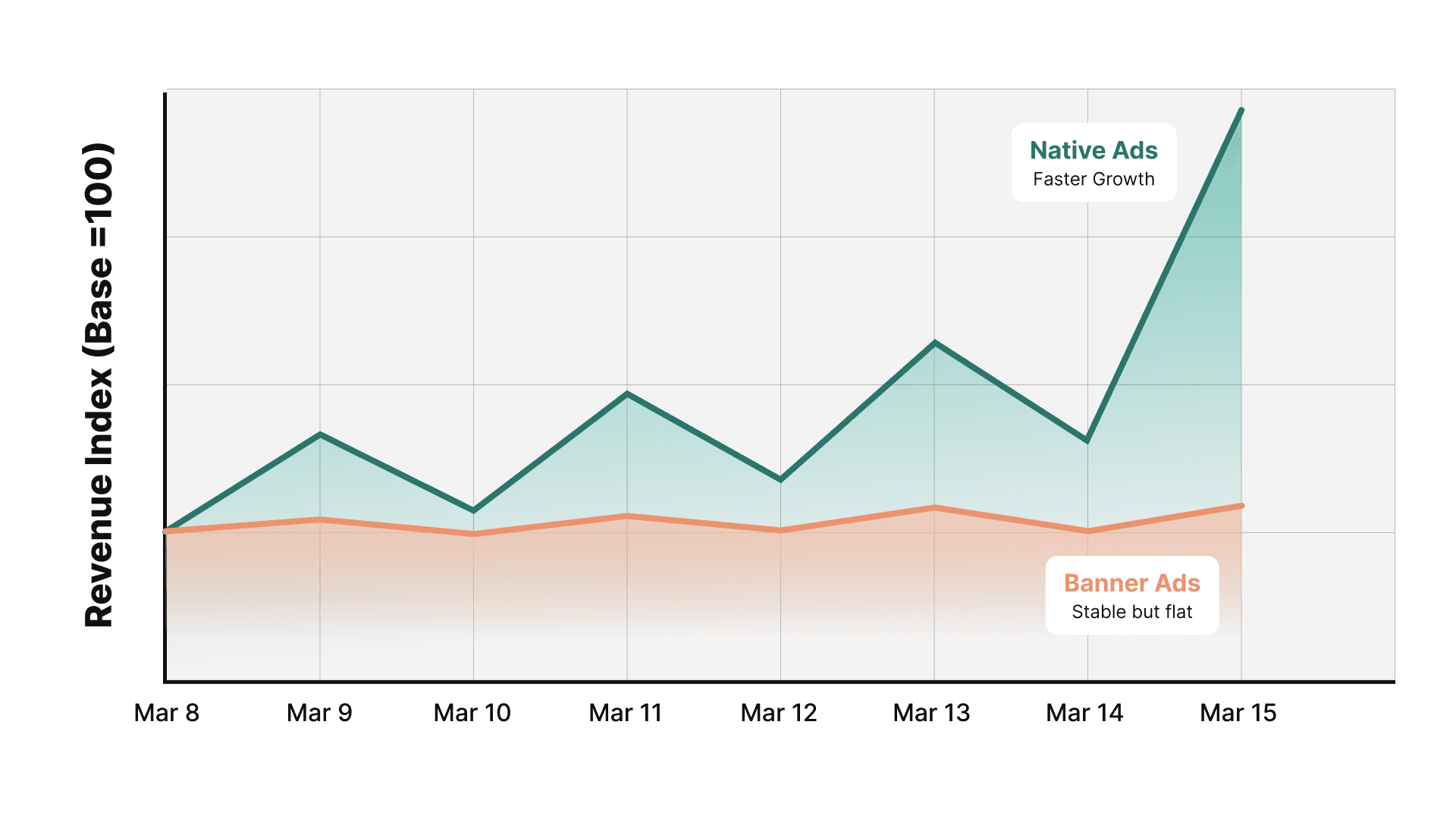 Revenue index: Native vs Banner ads
Native Monetization Efficiency
When the two formats were measured side by side, the performance difference was both clear and consistent. Native ads delivered 62% higher revenue despite serving 57% fewer impressions than Banner.
This is a meaningful result. It demonstrates that Native inventory is not just performing differently from Banner; it is monetizing at a structurally stronger yield level. The revenue gap between the two formats was not driven by one exceptional day or a temporary demand spike. It held consistently across the measurement period, reflecting a fundamental difference in how each format attracts and converts advertiser demand.
Several factors explain why Native performed at this level:
- Higher advertiser bid density - Native placements attract premium demand that competes more aggressively in auction, pushing CPMs higher on every impression
- Better user attention - In a calm, focused game environment, native ads receive more deliberate exposure from players who are not rushing through the experience
- Stronger click-through potential - Contextually integrated creatives that feel native to the game environment drive meaningfully higher engagement than static banner formats
- Premium inventory perception - Advertisers value native placements more highly, recognising the quality of the context in which their ads appear
- Non-disruptive experience - Because Native blends into the game rather than interrupting it, players remain engaged - and engaged players are more valuable to advertisers
Banner Volume Strength
Banner's role in the monetization mix remains important and should not be overlooked. Across the same measurement period, Banner delivered consistent large-scale traffic with stable daily output and a predictable revenue floor. Its core strength is reliability; it scales with traffic, fills consistently across demand conditions, and provides a dependable baseline that does not fluctuate with the same variability as Native's demand-driven CPMs.
Banner is not underperforming in absolute terms. It is doing what it is designed to do: generate broad, consistent coverage at scale. The insight from this analysis is not that Banner is failing, it is that Native, operating on a fundamentally different demand model, is generating significantly more value from each impression it serves. Both formats have a role; they simply play different positions within the overall monetization strategy.
The Results
Quality Over Quantity
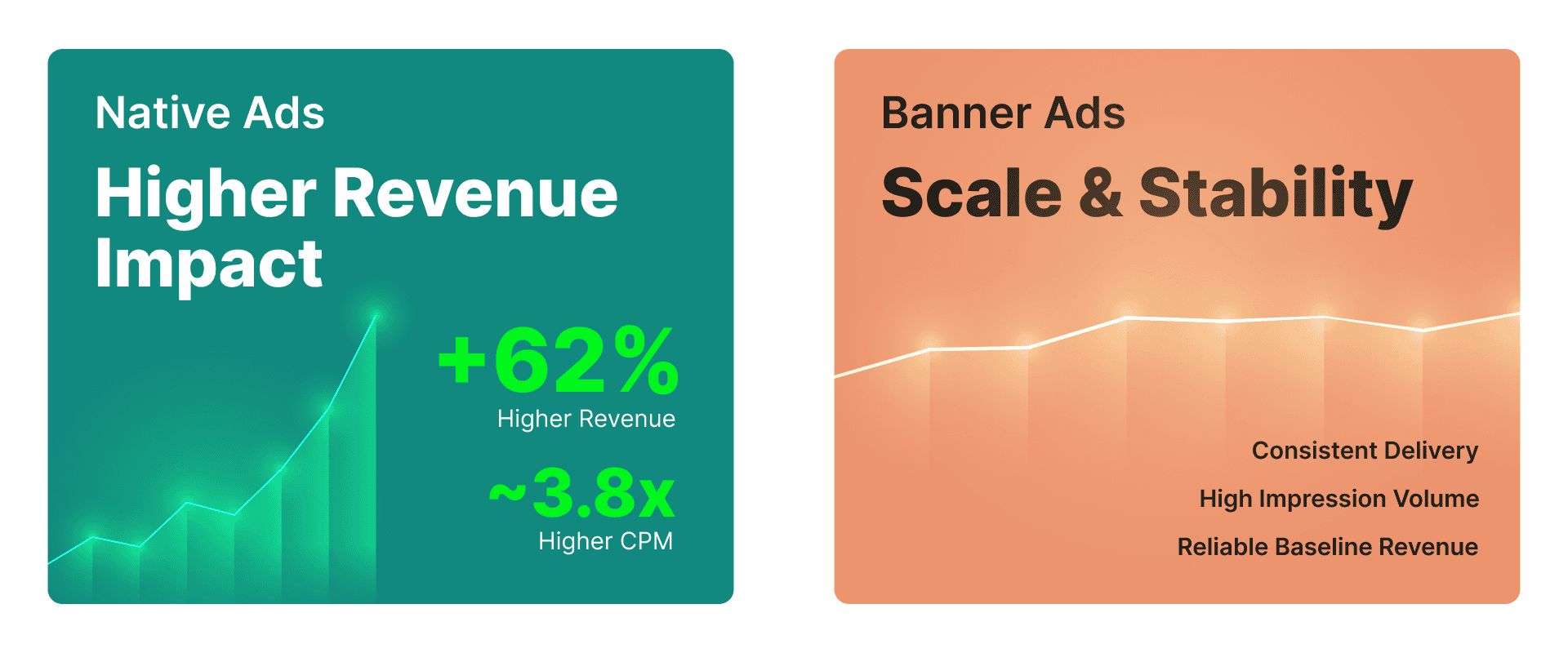 Native ads vs banner ads comparison
The performance comparison between Native and Banner surfaces one of the most important insights in mobile monetization: impression volume and revenue contribution do not always move in the same direction.
Native served 57% fewer impressions than Banner across the measurement period, yet generated 62% more revenue. This is not a case of one format failing and another succeeding. It is a reflection of how differently the two formats monetize within the same app environment, against the same audience, at the same time.
Banner operates on a volume model, broad reach, consistent delivery, and a revenue floor that scales predictably with traffic. It is a stable, reliable contributor that performs as expected across varying demand conditions. Native operates on a value model, fewer impressions, but each one attracting stronger demand, higher bids, and significantly greater revenue contribution per impression served.
On a per-impression basis, Native generates nearly 4x more revenue than Banner. A single Native impression is roughly equivalent to almost four Banner impressions in revenue potential. As impression volumes scale, this efficiency gap compounds, and it is precisely this dynamic that drove Native's stronger overall revenue contribution despite its lower traffic share.
Together, the two formats tell a story about complementary strengths rather than direct competition. Banner anchors the monetization baseline with volume and consistency. Native drives the yield with quality and efficiency. When both are running within the same environment, the combined strategy is stronger than either format operating alone.
Conclusion
Fusion Blocks makes the case clearly: revenue is driven by the value of each impression, not the volume of them.
Native operated with 57% fewer impressions than Banner, yet delivered 62% higher revenue. That result reflects a structural difference in how the two formats attract advertiser demand, with Native's stronger CPMs and higher bid density creating a yield advantage that scale alone cannot replicate.
Both formats have a role to play. Banner provides the volume and stability that anchors the monetization baseline. Native drives the yield that moves the revenue needle. Together, they form a stronger strategy than either format could deliver on its own.
For Fusion Blocks, Native is currently the primary revenue engine within that mix, and the data shows exactly why.
62% higher revenue. 3.8x stronger CPMs. 57% fewer impressions. Native doesn't win on volume. It wins on value.



The only ad platform built for developers by developers.
Contact us now for a product that fits your needs! It’s quick, simple and easy.