Se7en started with five games. PubScale’s GAM now runs across 40+ games.
Se7en
Publisher
PubScale GAM/AdX
Product
MAX Mediation
Integration Type
+1.5x
Daily Revenue Growth
Highlights
40+ Games on GAM
1.5x Daily revenue with GAM Native
48% ARPDAU uplift on top titles
The test was never whether GAM could make money.
Se7en's monetization stack was already working. That is exactly what made the decision difficult.
When a portfolio is performing, every new demand source carries the same unspoken risk. It might not add revenue at all. It might simply take impressions that were already being monetized elsewhere, post an impressive number against its own name, and leave the total flat. Publishers who have been through that once tend not to volunteer for it twice.
So Se7en did the sensible thing. They gave PubScale’s GAM five games.
Not the flagship titles. Not a portfolio-wide rollout. Five games, a small share of voice, and a clear condition attached: prove the contribution is incremental, and prove it without disturbing anything that already works.
That was the brief PubScale started with.
Small share of voice, no room for error.
A cautious rollout sounds easy to manage. In practice it is the hardest place to start.
With a narrow slice of inventory, there is very little room to absorb a bad week. Floors set slightly too high cost fill. Floors set slightly too low leave money on the table and make GAM look weaker than it is. Neither mistake stays quiet when the sample is small.
PubScale's response was to stop treating floors as a setting and start treating them as an operation.
Floors were monitored against live buyer behaviour and CPM movement, then adjusted continuously. Testing across daily and seasonal cycles produced a finding that runs against instinct: there is no correct floor. Lower floors performed better through weaker demand periods. Higher floors captured more when demand strengthened. The value was not in finding the right number once. It was moving with the market.
Throughout, the measure was total revenue rather than price. A rising CPM alongside a collapsing match rate is not a win, and it is one of the easier ways to make a dashboard look healthier than a business.
One floor for the world is one floor too few.
The next constraint was geographic.
A single global floor assumes advertisers value every market identically. They do not, and the gap between markets is often larger than the gap PubScale was optimizing for within them.
The team moved Se7en to a hybrid model, running global floors alongside country-targeted floors. Regions with stronger advertiser buying capacity were priced to capture that strength. Markets where a higher floor would only cost impressions were left to fill.
Same inventory. Different prices per market. More revenue in aggregate.
The moment the trajectory changed
Google launched a new feature called GAM Native.
PubScale moved on early, ahead of most of the market. There was one problem, and it was the kind that usually ends the conversation.
The standard path was new ad units and engineering time on Se7en's roadmap, which in practice means waiting. PubScale built a custom automated workflow instead.
Native ran through Se7en's existing Banner and MREC placements, The workflow was built and automated by PubScale, which saved manual input and scaled revenue performance.
So PubScale automated it: the workflow monitors performance continuously. Better efficiency from ad units Se7en already owned. No new placements, no development work.
Daily revenue moved to approximately 1.5x.
The part that does not fit on a slide
The remaining gains came from attention rather than insight.
Demand is not spread evenly across the day. PubScale monitored hourly performance by format, identified the windows where buying pressure peaked, and refreshed tags so that inventory was carried by the strongest tags at precisely those hours.
There is no clever mechanism to describe here. It is monitoring, and then acting on what the monitoring shows, every day. It is also a meaningful share of the compound result.
Where it landed
From 5 games to 40+. The expansion was earned rather than mandated. Each wave of titles followed evidence from the last, which is why GAM ended up across the portfolio instead of parked permanently in a test bucket.
~8% ARPDAU uplift across top-performing games. The uplift was not uniform, and the strongest segments were considerably stronger than the average suggests:
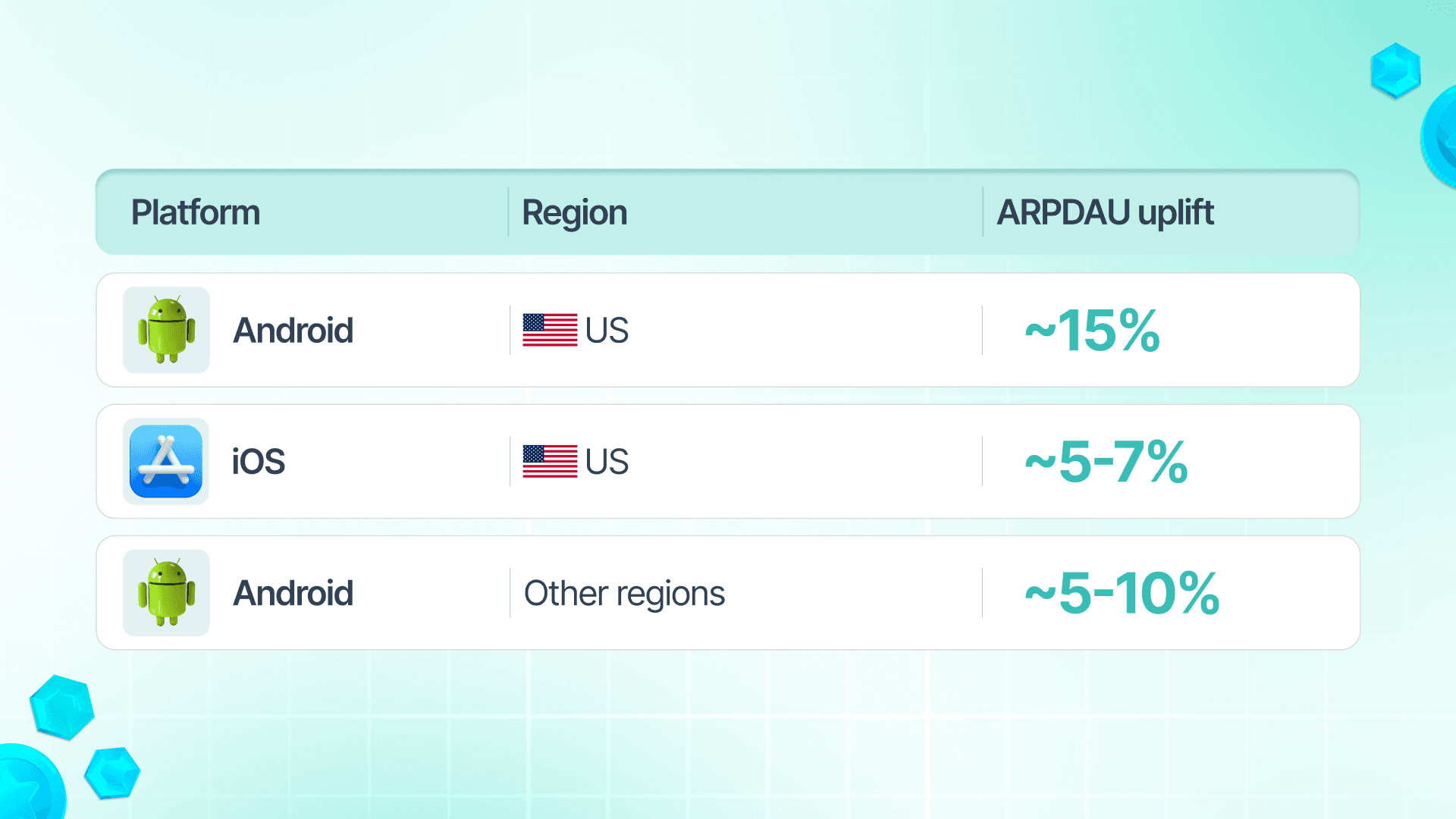 Se7en ARPDAU
~8% GAM SOV in top titles. GAM is no longer a trial placement in Se7en's highest-earning games. It holds a standing share of the waterfall and competes for it on every impression.
~1.5x daily revenue after GAM Native. The single largest step change in the engagement, and one that came from removing an integration obstacle rather than from bidding harder.
CPM performance held while the portfolio grew eight-fold. Scaling a demand source across more titles usually dilutes average CPM as weaker inventory enters the mix. Continuous floor and refresh work kept CPM performance strong through the expansion, which is what made scaling worth doing rather than simply larger.
What Se7en actually bought
Not a demand source. Se7en already had those.
What they added was a team treating GAM as a live position to be managed daily, across floors, geographies, formats, and hours. Five games became 40+ because the numbers kept justifying the next step.
If GAM is currently running as a side experiment in your portfolio, PubScale can tell you what it looks like at full contribution. Talk to the team.



The only ad platform built for developers by developers.
Contact us now for a product that fits your needs! It’s quick, simple and easy.